Principle of Least Privilege: The most dangerous access is the one everyone forgot about
Cyberattacks begin when vulnerabilities or forgotten, unnecessary privileges remain unaddressed.
Domain Admin accounts, Local Administrator rights, and forgotten access permissions often seem harmless. They are granted for practical reasons, solve immediate problems, and gradually persist. Over time, these minor choices can become major business risks.
Would your organisation be able to answer, with confidence, exactly who has access to what?
Why the Principle of Least Privilege matters
When organisations discuss cybersecurity, the focus typically falls on ransomware, zero-day vulnerabilities and sophisticated attack techniques. Yet penetration tests and incident investigations often reveal a different reality.
Many damaging compromises stem from attackers exploiting outdated or unnecessary permissions, accounts, or access paths.
This is why understanding and applying the Principle of Least Privilege (PoLP) is critical: it forms a key defence against these silent, accumulating risks.
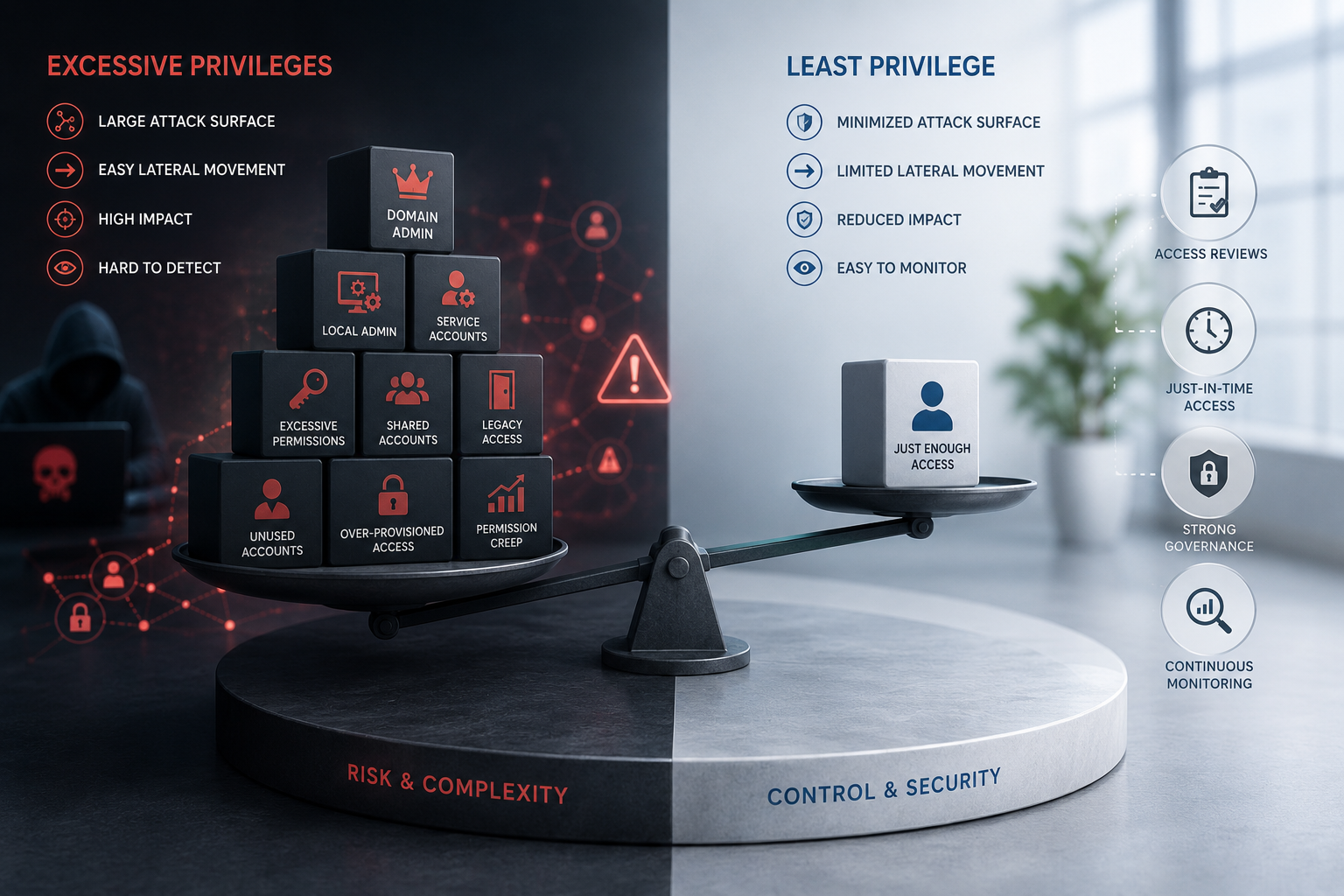
The principle is straightforward: Every user, application, service account and system component should only have the permissions required to perform its intended function – and nothing more.
Simple in theory, but very challenging in practice.
How excessive privileges accumulate
Organisations are constantly evolving. New projects emerge, systems are introduced, employees change roles, and responsibilities shift. Every change creates new access requirements.
Permissions are often granted more than revoked. An employee joins a project and gains extra access. Temporary admin rights fix urgent issues. A service account gets elevated access to support integration. Months or years later, these rights often still remain.
Over time, users and accounts often retain access beyond what current roles require, creating unnoticed risks that attackers can exploit.
Domain Admin accounts: A high-value target
Within an Active Directory environment, few assets are more attractive to an attacker than a Domain Admin account. Compromising such an account can provide access to virtually the entire enterprise infrastructure.
An attacker may be able to:
- create new users;
- modify permissions;
- access sensitive information;
- control critical servers;
- establish long-term persistence.
During penetration tests, we still regularly encounter organisations that use Domain Admin accounts for everyday operational activities.
Takeaway: Each additional privileged credential increases potential attack paths and risk of compromise. Managing privileged accounts tightly is essential.
Larger organisations increasingly adopt tiered administration models, separating the management of workstations, servers and identity systems to reduce this exposure.
Modern approaches to privileged access
Leading security frameworks consistently recommend separating standard user accounts from administrative accounts. Users should not perform day-to-day activities using highly privileged credentials. The number of Domain Admin accounts should also be kept to an absolute minimum. However, mature organisations are increasingly moving beyond account separation alone.
Privileged Access Management (PAM) solutions are becoming standard practice across Europe and other mature markets. These solutions enable time-limited, auditable and tightly controlled administrative access.
Grant elevated rights only when justified and for a defined period to minimise business impact.
Local Administrator rights: Convenience with consequences
Local Administrator rights are often granted for convenience. Users may need to install software, change settings, or troubleshoot. This can improve short-term efficiency but expands the attack surface.
If malware or an attacker gains access to a workstation where the user holds Local Administrator rights, several attack techniques become substantially easier.
These privileges may enable:
- security control bypasses;
- malicious software installation;
- credential theft;
- lateral movement across the network.
Ransomware damage increases when attackers exploit excessive local privileges to move within the environment.
PoLP extends beyond users
The Principle of Least Privilege applies far beyond employee accounts. Service accounts, automation processes, APIs, cloud integrations and business applications all represent potential attack paths.
A compromised application can only cause as much damage as its assigned permissions allow. If an application has unrestricted database access, an attacker effectively inherits that capability.
Key takeaway: Limiting each application’s permissions restricts attacker movement, helps stop attacks earlier, and protects critical systems.
The key question is not whether attackers get in
Modern security strategies increasingly assume that initial compromise is possible. A phishing email, stolen credentials or an exploitable vulnerability may eventually provide an entry point. The more important business question is what happens next.
A well-designed privilege model can:
- restrict lateral movement;
- limit privilege escalation;
- reduce business impact;
- slow attacker progression;
- improve detection opportunities.
Excessive permissions achieve the opposite. They can transform a minor compromise into a major business incident.
The right executive questions
Technology alone rarely provides a complete picture of access control maturity. Instead, organisations should regularly ask:
- How many Domain Admin accounts currently exist?
- When was the last access review conducted?
- How many employees have Local Administrator privileges?
- Are service account permissions regularly reviewed?
- How quickly could we identify a compromised privileged account?
These are not technical questions, but questions about visibility, governance and risk management. If the answers are unclear, difficult to obtain or unavailable, the issue is unlikely to be technological.
It is far more likely to be a lack of visibility into who has access to what and why. Attackers tend to exploit exactly these blind spots.
The Principle of Least Privilege creates control
The Principle of Least Privilege should not be viewed as a compliance exercise completed before an audit. It is one of the most effective controls available for reducing attack surfaces, limiting business impact and strengthening organisational resilience.
As penetration testers, we repeatedly observe that the most serious incidents are rarely caused solely by technical weaknesses. More often, they stem from excessive trust and years of accumulated access permissions.
The real question is not whether a privilege management process exists, but whether the permissions currently in place are genuinely justified.
If you are unsure whether your organisation’s access model truly follows the Principle of Least Privilege, a targeted security assessment or penetration test can quickly reveal hidden risks. Let’s discuss which privileges may represent business-critical risks within your environment today! Contact us!