Directory listing as a security risk
Most attacks do not begin with the discovery of a critical vulnerability. They begin with reconnaissance. In many cases, attackers do not even need specialised tools to gather valuable information – because the web server willingly reveals where to look and what to examine.
Directory listing is one such source of information. To an ordinary user, it is little more than a list of files. To an experienced attacker, however, it is the equivalent of leaving the floor plans, office directory and employee list on the reception desk of a secured office building. No one gains immediate access to the building, but they quickly learn which door is worth knocking on first – and when.
What is directory listing?
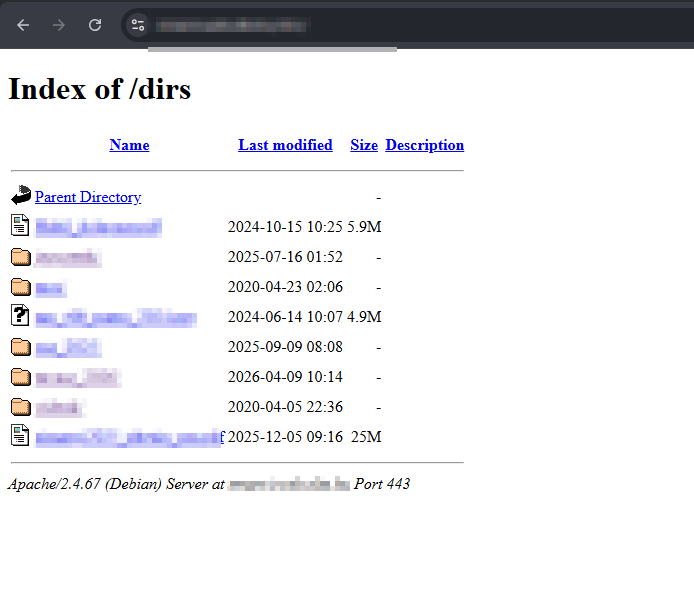
Directory listing occurs when a web server automatically displays the contents of a directory to visitors. This typically happens when the directory does not contain a default index page and the web server is configured to allow directory browsing.
Instead of returning an error or loading an application page, the browser simply displays the files and subdirectories contained within that directory.
Why does directory listing represent a security risk?
Simply knowing file names or understanding a directory structure does not provide direct access to sensitive information. The real risk lies in the visibility it provides. A directory listing can reveal valuable details about an application’s structure, allowing attackers to bypass much of the reconnaissance that would otherwise be required. Instead of discovering the application’s architecture themselves, they are presented with a roadmap by the server itself.
From our experience conducting penetration tests, attackers rarely begin by searching for critical vulnerabilities. Their first objective is to understand what the application reveals about itself.
The reason is straightforward: an exposed directory listing often provides more useful intelligence than pages of technical documentation. The risk becomes significantly greater when publicly accessible directories contain files that were never intended for public access, such as archived application versions, backups, exported datasets, testing artefacts, technical documentation, configuration files, or log files.
Although these files may not contain sensitive data on their own, they can disclose the technologies powering the application, reveal elements of the system architecture or reference forgotten endpoints and services that are still accessible.
Individually, each piece of information may appear insignificant. Together, they gradually provide attackers with the context they need to identify and exploit more meaningful attack paths.
If you are not sure what information your web application reveals to an external observer, it is worth carrying out an application security review from time to time. A well-structured penetration test not only identifies vulnerabilities but also exposes less obvious behaviours that may provide an experienced attacker with a valuable starting point.
Get in touch with Whiteshield, and let’s examine what your application is showing to the outside world!