
Public information can expose more than expected
We identify what can be discovered about your organisation through publicly available data before it is used against you.
Your organization may already be exposed
Publicly available information can reveal how your organisation operates, who your key people are, and what technologies you rely on.
This information is often fragmented, but when combined, it provides attackers with a clear picture.
No direct access required
Attackers collect information without interacting with your systems.
Company data, employee details, and infrastructure clues are often publicly accessible.
Your organization becomes visible
Collected information can be combined to understand structure, technologies, and relationships.
This enables targeted attacks and social engineering.
Before anyone notices
The entire process happens without detection.
No alerts, no logs, no indication that your organisation is being mapped.
Be ready for attackers, book a consultation!
How we assess your public exposure
Our OSINT assessments follow a structured approach focused on how publicly available information can be collected, correlated, and used in real-world attack scenarios.
We combine automated data collection with manual analysis to identify meaningful connections and potential risks.
Scope Definition
We conduct black-box OSINT using predefined domain names and related assets.
The objective is to identify additional domains, email addresses, and publicly available information connected to your organisation.
Data Collection
The assessment relies on publicly available data sources and passive techniques.
This includes open databases, search engines, and OSINT-specific tools to gather information without direct interaction with the target systems.
Exposure Identification
Findings may include data associated with:
- employees of the identified domains
- related companies or entities
- previously used company names
This helps reveal how publicly available information can extend beyond the expected scope.
Data Sources & Techniques
We use a combination of investigative techniques and tools, including:
- Google dorking techniques
- passive automated tools
- OSINT investigation platforms
Both free and commercial tools may be used, depending on the assessment context.
Findings
The results are presented in structured tables that include both raw data and supporting context.
In a typical assessment, this may include:
- identified email addresses linked to individuals
- connections to related domains
- historical or cross-organisational references
Reporting
All findings are documented in a structured format to support further analysis and decision-making. Our reporting system is easily accessible to the technical team and decision-makers alike.
OSINT insights and real-world cases
Insights and real-world examples showing how publicly available information can be used to map organizations, identify individuals, and prepare targeted attacks.
Be ready for everything, stay safe!
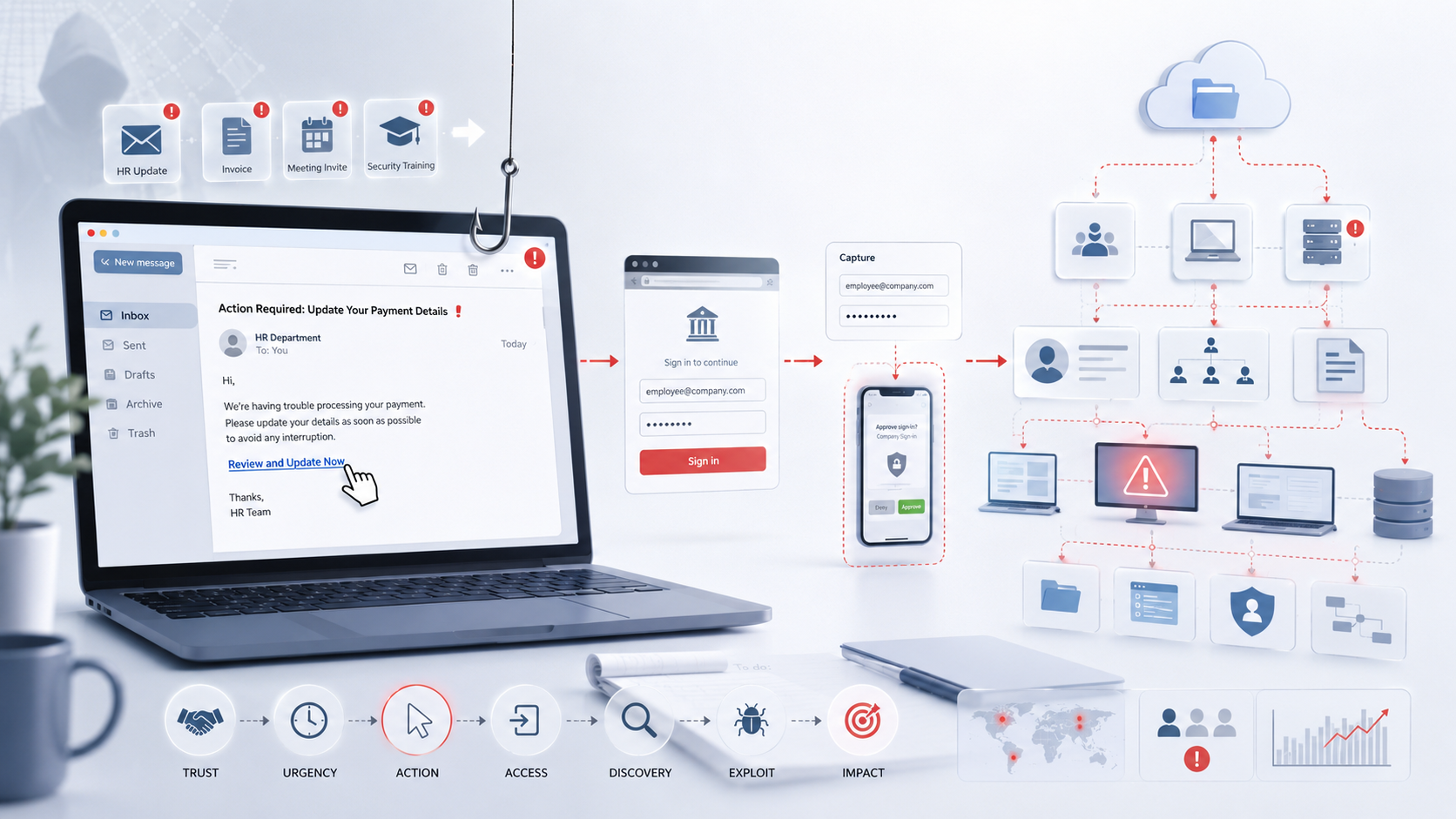
Phishing and Social Engineering: How Attackers Compromise Your Company with a Single Click
Phishing: The attacker is not hacking your systems – they are hacking your employees Fact: even the most expensive security stack can be bypassed with a well-written email. We wish we could say that it is a poetic exaggeration, but unfortunately, it is not. This is a…

What Does an Ethical Hacker Do? | Business-Focused Guide
What does an ethical hacker do? – And why it is a business question Spoiler: an ethical hacker – aka pentester – is not sitting in a dark basement wearing a black hoodie. Even if Hollywood has done a remarkably good job convincing us otherwise. So what does an ethical…
Security Starts With a Conversation
Skip the sales pitch. Have a high-level conversation about your business
continuity and operational risk.